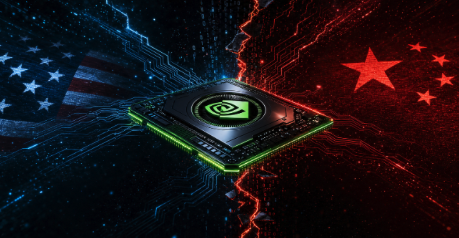
No single piece of silicon better illustrates the fracture lines of the US–China technology rivalry than Nvidia’s H200 AI chip. It is simultaneously approved for export, blocked from import, in demand by Chinese firms, and suppressed by Beijing — a paradox that encapsulates everything broken about the current geopolitical moment.
Approved in Washington, Blocked in Beijing
In January 2026, the Trump administration formally greenlighted Nvidia H200 exports to China, ending a long-standing prohibition — but with significant strings attached. Shipments cannot exceed 50% of Nvidia’s domestic US sales volume; Chinese buyers must demonstrate adequate security measures; and each chip must be verified by a US-headquartered third-party laboratory before it can ship. Crucially, the framework requires chips to transit through a US facility before reaching China, enabling the US government to levy a 25% tariff — effectively taking a cut of every sale.
Despite this, not a single H200 has been sold to a Chinese customer. Within days of Washington’s approval, Chinese customs officials were quietly instructed to block H200 imports at the border. Beijing simultaneously called on domestic technology companies to avoid purchasing the chips unless absolutely necessary — steering them instead towards homegrown alternatives such as Huawei’s Ascend series. The result is a regulatory impasse: Washington says yes, Beijing says no, and Nvidia sits in the middle watching billions in potential revenue evaporate.
Jensen Huang Boards Air Force One
The stakes became dramatically visible this week when Nvidia CEO Jensen Huang boarded Air Force One in Alaska at the last minute, joining President Trump’s delegation for the Beijing summit. For nearly a year, Huang has been lobbying officials in both Washington and Beijing to unlock H200 sales, making him arguably the most commercially invested figure in the entire diplomatic visit. The US also reportedly cleared approximately ten Chinese firms — including Alibaba and ByteDance — to acquire H200 chips, though no orders have materialised due to Beijing’s quiet suppression of demand.
The MATCH Act and Tightening Controls
Whilst Huang lobbies for market access, Capitol Hill is moving in the opposite direction. China publicly criticised the proposed MATCH Act in the days leading up to the summit — US legislation designed to restrict Chinese chipmakers from competing in the AI race and tighten controls on advanced semiconductor exports. The House Foreign Affairs Committee has also advanced broader AI chip export control legislation, including measures targeting chip smuggling networks, which intelligence assessments suggest are actively routing Nvidia hardware to China and Russia via third-party intermediaries.
The tension is structural: the US Commerce Department wants to retain some leverage over China’s AI development whilst preserving Nvidia’s commercial competitiveness; national security hawks want a near-total embargo; and Beijing is playing both sides — publicly denouncing export controls whilst quietly building domestic alternatives.
The Bigger Picture
The H200 saga is not simply a story about one company’s revenue. It is a proxy war for the future of AI supremacy. Every quarter that Chinese firms cannot access leading-edge US chips is a quarter in which domestic alternatives — Huawei’s Ascend, Cambricon, and Biren — gain ground. Conversely, every H200 that reaches China is a chip that could, in theory, contribute to military AI applications that Washington has spent years trying to prevent.
This week’s summit may determine whether the H200 logjam breaks — or whether it hardens into permanent technological decoupling.