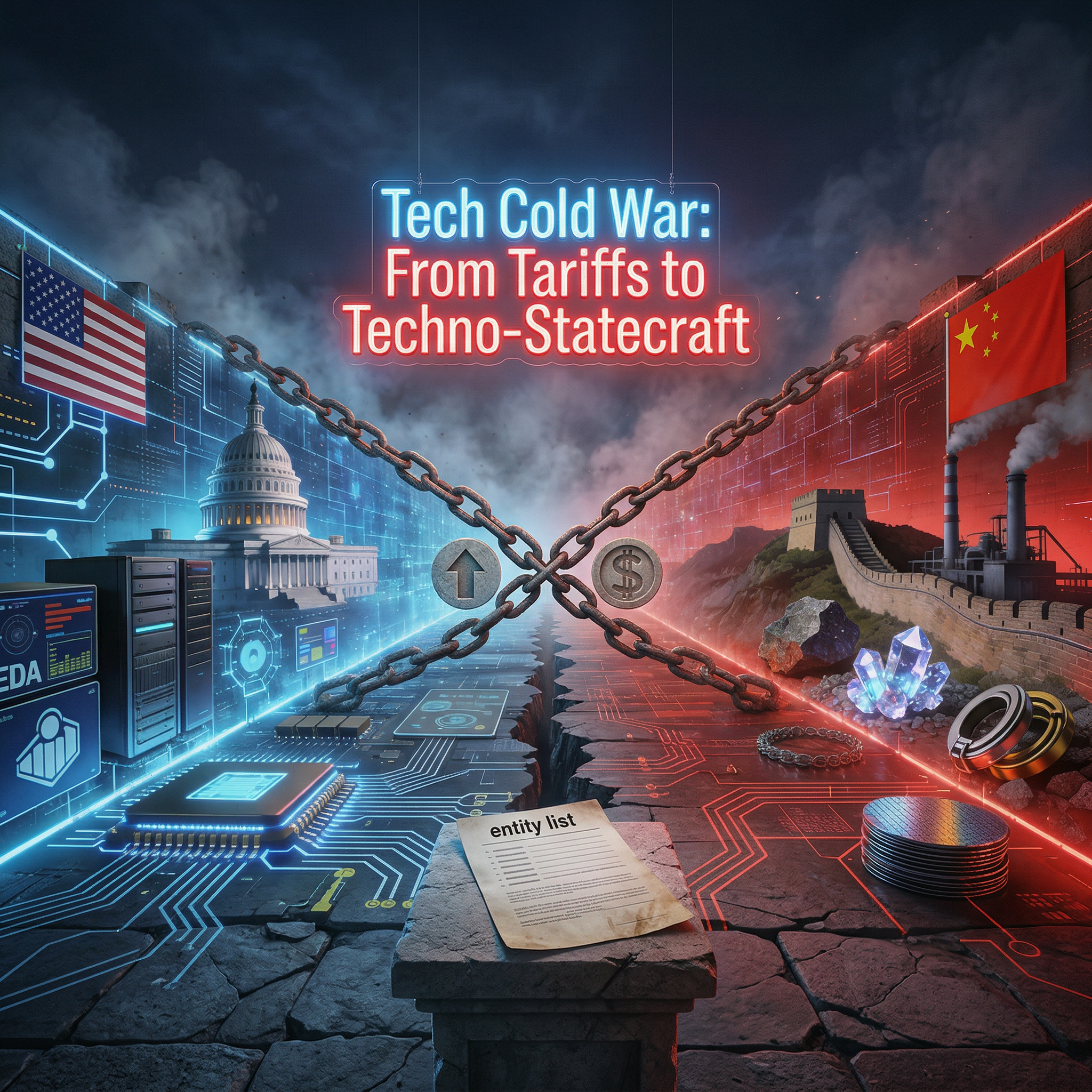
In the U.S.–China tech confrontation, the question is no longer who sells more; it is whose revenue can be switched off by politics and by how much. On both sides of the Pacific, tens of billions of dollars in technology income now live or die by government decree rather than customer demand. Politically exposed revenue (PER) has become a central metric of vulnerability and leverage in the global technology economy.
What PER Means in a US–China Context
Politically exposed revenue is the portion of a company’s income that depends on continued political permission from a foreign state, or from the company’s own government, to serve specific markets and customers. It is not general country risk or foreign‑exchange volatility. It is targeted, binary and exogenous: one regulatory change or export‑control rule can collapse a healthy business line in a stable market.
In the U.S.–China relationship, PER shows up wherever:
- U.S. rules decide which technologies can lawfully flow into China.
- Chinese rules and informal guidance decide which foreign vendors can access local demand, data and infrastructure.
- Third‑country governments copy or adapt restrictions from either side.
Under this lens, the question “Who has more PER?” becomes: whose corporate earnings depend more heavily on political forbearance from the other side?
For Investors: Where Does the PER Burden Sit?
From an investor’s standpoint, U.S. and allied firms still carry the larger absolute PER exposure into China, while Chinese champions carry a high, but increasingly regionalized, PER exposure into the U.S. and allied markets.
On the U.S./allied side, leading chip designers and cloud providers once treated China as a long‑term, high‑growth pillar of earnings. For some, China accounted for around a fifth or more of revenue in key segments. When export‑control thresholds tightened and Chinese demand was steered to domestic alternatives, that revenue did not gradually decelerate; it was reclassified as contingent and, in some cases, written down to near zero.
Also, semiconductor equipment vendors in the U.S., Europe and Japan built factories, service networks and roadmaps around a customer base in which China represented 20–40% of annual sales in some years. That income is now segmented into licensed business versus potential future denials.
Meanwhile, on China’s side, Huawei’s experience has become emblematic of a fraught situation for its technology enterprises. Before U.S. sanctions hit the company, most of Huawei’s top‑line growth came from global smartphone and network‑equipment sales. Sanctions slashed overseas revenue and drove a sharp profit decline, but the company rebuilt around domestic demand and “friendly” markets; China’s share of its revenue climbed while its non‑China markets shrank.
Consumer‑internet and app companies such as ByteDance depend heavily on U.S. and European users and advertisers. Every debate over bans, forced divestments or data‑security conditions effectively puts a portion of their revenue under political review.
The pattern for investors is clear:
- In gross dollar terms, more PER still sits on US’ and its allies’ balance sheets aimed at China, because Western firms sunk more capital into the Chinese demand story.
- In relative dependence, many Chinese firms have been forced to pivot inward or south‑south, making their remaining U.S./EU exposure more fragile but smaller as a share of total revenue.
For capital markets, PER should no longer be treated as a narrative nuance. It is a valuation variable: the part of earnings per share that can disappear because someone in Washington or Beijing signs a document.
3. For Boards: The Bidirectional Trap
Several flagship companies are, or have been, caught in a bidirectional PER trap: exposed simultaneously to U.S. decisions about what may be sold and to Chinese decisions about what may be bought.
Consider three archetypes:
1. The advanced chip supplier
Nvidia, a leading manufacturer of GPUs, built China into a critical growth engine for its data‑center business. At one point, roughly a quarter of revenue in that segment came from Chinese demand. Export controls then drew a moving line across its product stack: first the top SKUs, then custom “China‑compliant” variants were constrained. At the same time, Chinese policy and corporate decisions accelerated the shift to domestic accelerators. A large, high‑margin revenue stream migrated from “core” to “politically exposed” and then, effectively, to “lost.”
Board implication: any new product designed “just for China” or “just below the control threshold” is inherently PER. It should be treated as opportunistic income, not as a pillar for long‑term guidance.
2. Mutual Dependence: Huawei and its Western suppliers
Before sanctions, Huawei was a crucial buyer of U.S. chips, EDA tools and test equipment. For some suppliers Huawei represented a mid‑single‑digit share of total revenue and a much larger share of growth. When restrictions tightened, that income vanished for U.S. vendors, while Huawei’s own foreign revenue in smartphones and network gear collapsed.
The Chinese company responded with a domestic pivot — new handset lines, in‑house chips, and deeper embedding in China’s 5G and cloud build‑out — recapturing total top‑line but shifting its geographic mix.
Board implication: dependence on a major foreign customer whose home state is in strategic confrontation with your own is not a commercial risk; it is PER. Symmetry does not protect you.
3. The global platform manufacturer
A major device and platform provider straddles both worlds. China is simultaneously:
- A primary manufacturing base.
- A top‑tier end market.
- A regulatory environment with its own content, data and procurement rules.
Meanwhile, the firm is publicly aligned with U.S. policy on supply‑chain security and data governance. It is exposed to:
- U.S. mandates to reduce critical manufacturing reliance on China.
- Potential Chinese regulatory or informal pressure that could affect its sales, services, or brand positioning.
Board implication: this is not a classic diversification problem. It is a multi‑sovereign compliance problem in which manufacturing geography, data governance and political signaling jointly define PER.
Across these cases, board‑level actions should include:
- Mapping “core” vs “politically exposed” revenue by geography, technology and customer type.
- Stress‑testing financials against explicit political shocks: loss of X% of China revenue, forced restructuring of U.S. or EU operations, bans on specific products.
- Interrogating whether market‑specific SKUs are building defensible positions or merely training and bridging to local substitutes.
4. Managing Security Without Engineering Backfire
Regulators on both sides face a tension between legitimate security aims and the risk of self‑inflicted damage. Politically exposed revenue is where that tension becomes measurable.
On the U.S. and allied side, the goals include limiting adversarial access to advanced computing technology, design tools, and manufacturing capacity that could enhance military or coercive capabilities. America also wants to reduce systemic dependence on high‑risk vendors in critical infrastructure.
On the Chinese side, the objectives are the achievement of greater autonomy in critical technologies; retaining leverage over global supply chains and markets where China is a central node and; protecting data, political stability and industrial policy priorities.
The problem is that PER often expresses mutual backfire:
- Controls can accelerate domestic substitution for the targeted firm while cutting off revenue for the controlling side’s own champions.
- Aggressive measures against foreign apps or devices can invite reciprocal steps against one’s own platforms abroad.
- Uncoordinated actions among allies or partners can fragment markets further, forcing companies to build separate product, cloud and compliance stacks.
Regulators need to grapple with three questions:
- How do we design controls that are narrow enough to address specific security threats without turning entire segments of commercial revenue into expendable collateral?
- How do we avoid policies that make targeted firms stronger at home and more aligned with rival industrial strategies, while undermining our own suppliers’ global scale?
- How do we measure the cumulative macro impact of PER—on innovation, prices, and cross‑border knowledge flows—rather than treating each control decision as an isolated technical tweak?
In a world of structural PER, “tech industrial policy” is not just about subsidies and reshoring; it is about recognizing that each new restriction rewrites revenue maps for firms on both sides.
5. Conclusion: From More Revenue to Resilient Revenue
The deeper contest between China and America is not simply for more technology revenue; it is for revenue that politics cannot easily take away. In the old globalization model, investors rewarded growth wherever it appeared, and boards optimized for efficiency. In the new model, they must ask: which revenues are strategically resilient, and which are politically exposed?
For investors, that means applying a PER discount to earnings streams dependent on foreign policy for their survival. For boards, it means rebuilding strategy around multi‑system realities, not the fiction of a single, neutral global market. For regulators, it means accepting that every export license, sanctions list and security review is now an instrument that reshapes not just security exposure, but the balance sheet of global technology itself.
The map of politically exposed revenue between China and America is, in effect, the new balance sheet of techno‑statecraft.
Bolaji Ojo is founder and principal analyst at GeoTechNexus. He is reachable at bojo@geotechnexus.com.