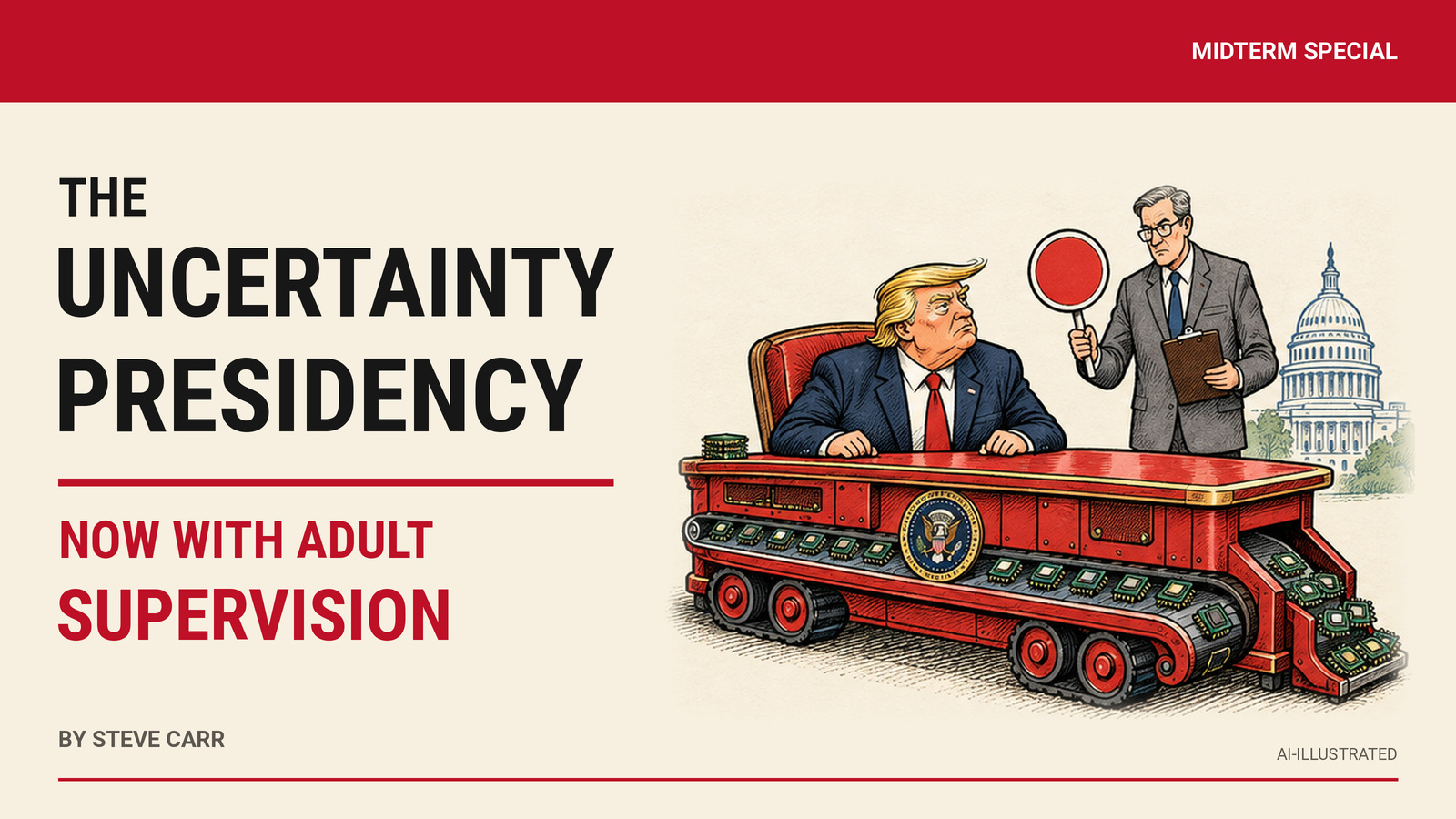

In poker, a “tell” is the involuntary signal a player gives off about the strength of their hand. The trick is not to listen to what they say, but to watch what they do — and, crucially, what they decline to do. Washington’s technology policy in mid-2026 is a masterclass in tells, and most commentators are reading the wrong ones. They focus on the loud announcements: the tariffs, the export-control expansions, the reshoring billions. The more revealing signal is quieter, and it is a non-action. The United States has approved a blacklist of more than 100 Chinese firms — and then deliberately chosen not to publish it. If you want to understand where US-China technology policy is actually heading, that restraint is the tell worth reading.
The two tracks, laid side by side
Start with what is visible, because the contradiction is the whole point. On one track, the US is spending and restricting with conviction. The CHIPS Act framework continues to underwrite domestic fabrication through grants and a 25% investment tax credit, with fresh awards still flowing — half a billion dollars to a single AI-materials firm as recently as this month. A US House panel has cleared twenty new export-control measures aimed at curbing China’s access to advanced semiconductor technology. And on 31 May the Bureau of Industry and Security extended licensing requirements for advanced AI chips to any company with a Chinese parent or headquarters, wherever in the world that subsidiary sits — an explicit move to close the overseas-subsidiary loophole.
That is the track everyone reports. Now look at the other one. An interagency committee — drawing on Commerce, Defense, Energy, State and sometimes Treasury — approved adding DeepSeek, the memory-chip maker CXMT, and more than 100 other entities to the Commerce Department’s Entity List last year. And then the Commerce Department simply never published the listing. At least 75 of those Chinese entities are involved in advanced semiconductor production, manufacturing equipment or AI modelling — exactly the targets the loud track claims to be containing.
The restraint is not an oversight. It is the longest interval without an Entity List addition in over a decade — no new entries since October. When a tool that has been used reflexively for ten years suddenly goes quiet, that silence is policy.
Why the blacklist is sitting in a drawer
The proximate reason is straightforward: the administration is trying to avoid escalating tensions with Beijing while trade negotiations remain live and fragile. The under-secretary for industry and security has reportedly sought to hold back new Chinese listings precisely to keep the temperature down. The blacklist, in other words, is being held as a bargaining chip rather than spent as a weapon.
But the deeper reason is that the leverage may be evaporating. In April, DeepSeek’s V4 model — among the most capable open-source systems in the world — launched running entirely on Huawei Ascend silicon, not NVIDIA. That single fact reframes the entire export-control logic. The implicit theory of the controls was that denying China the best chips would slow its AI progress. If a frontier model can now run on domestic Chinese hardware, blacklisting DeepSeek punishes a firm that no longer depends on the thing being denied. The tell here is uncomfortable for Washington: holding back the listing may be less about diplomacy and more about not wanting to demonstrate, publicly, that the primary instrument has lost its bite.
China, for its part, is reading the same board and raising. This week Beijing added ten US firms to its own export-control list — including the rare-earth miner MP Materials and USA Rare Earths — and barred government procurement from some fifty US companies, retaliating against a Pentagon move to blacklist around eighty Chinese firms. The escalation is real, but it is being conducted through carefully chosen, reciprocal moves rather than blanket bans. Both sides are signalling resolve while leaving room to retreat.
What the reshoring track is really telling us
The subsidy track carries its own tell, and it is one of hedging rather than confidence. The headline reshoring announcements have a habit of being louder than the commitments beneath them. A widely trumpeted Apple-Intel arrangement was announced by the government via social media, yet neither company has formally confirmed it, and analysts caution that any deal may prove far narrower than the announcement implied, with key commitments months away. Meanwhile the administration is reviewing the terms underpinning existing CHIPS Act awards, putting some $39 billion of subsidies under fresh conditions.
Read together, the reshoring track signals a government that wants the optics of decisive industrial policy while keeping its actual obligations flexible. That is not a criticism so much as a diagnosis. A state that genuinely believed it could decouple cleanly would not need to hold a blacklist in reserve or keep its subsidy terms open for revision. The hedging is the honest part of the policy.
The strategic intent, decoded
So what is the playbook? My reading is that Washington has quietly shifted from a containment posture to a managed-competition posture, without ever announcing the change. The rhetoric remains containment — tough, decisive, decoupling. The behaviour is management — calibrated, reversible, and careful not to provoke a response it cannot match. The dual track is not incoherence; it is strategic ambiguity, deliberately maintained.
For technology leaders, three implications follow, and none of them are comfortable.
First, do not plan around the rhetoric; plan around the behaviour. The loud announcements are negotiating posture. The quiet restraint — the unpublished blacklist, the reviewed subsidy terms, the unconfirmed reshoring deals — is the real signal. Build your scenarios on what the US is actually willing to do, which is rather less than it says.
Second, assume the controls are reversible in both directions. A blacklist that can be held in a drawer can also be deployed overnight, and a truce that lifted the gallium and germanium curbs can be reimposed. The policy environment is now a dial, not a switch, and the dial moves with the negotiation cycle. Anything you build that depends on the current setting is exposed to the next phone call between capitals.
Third, recognise that the leverage is shifting. The DeepSeek-on-Huawei moment suggests the denial strategy is reaching its limits, while China’s willingness to retaliate on rare earths and procurement shows where Beijing’s leverage is growing. The smart money assumes the US will increasingly lead with subsidy and industrial policy — building capacity it controls — because the sanction track is delivering diminishing returns.
The bottom line
The most important thing Washington has done in technology policy this year is something it chose not to do. A blacklist of over a hundred firms, approved and ready, sits unpublished because publishing it would either blow up a negotiation or, worse, reveal that the weapon no longer fires the way it used to. That is the tell. Watch the non-actions, price in the reversibility, and build your strategy on the assumption that the next eighteen months will be managed competition dressed in the language of decoupling. The players at the table are bluffing and hedging in equal measure. Your job is not to believe the talk — it is to read the hands.