
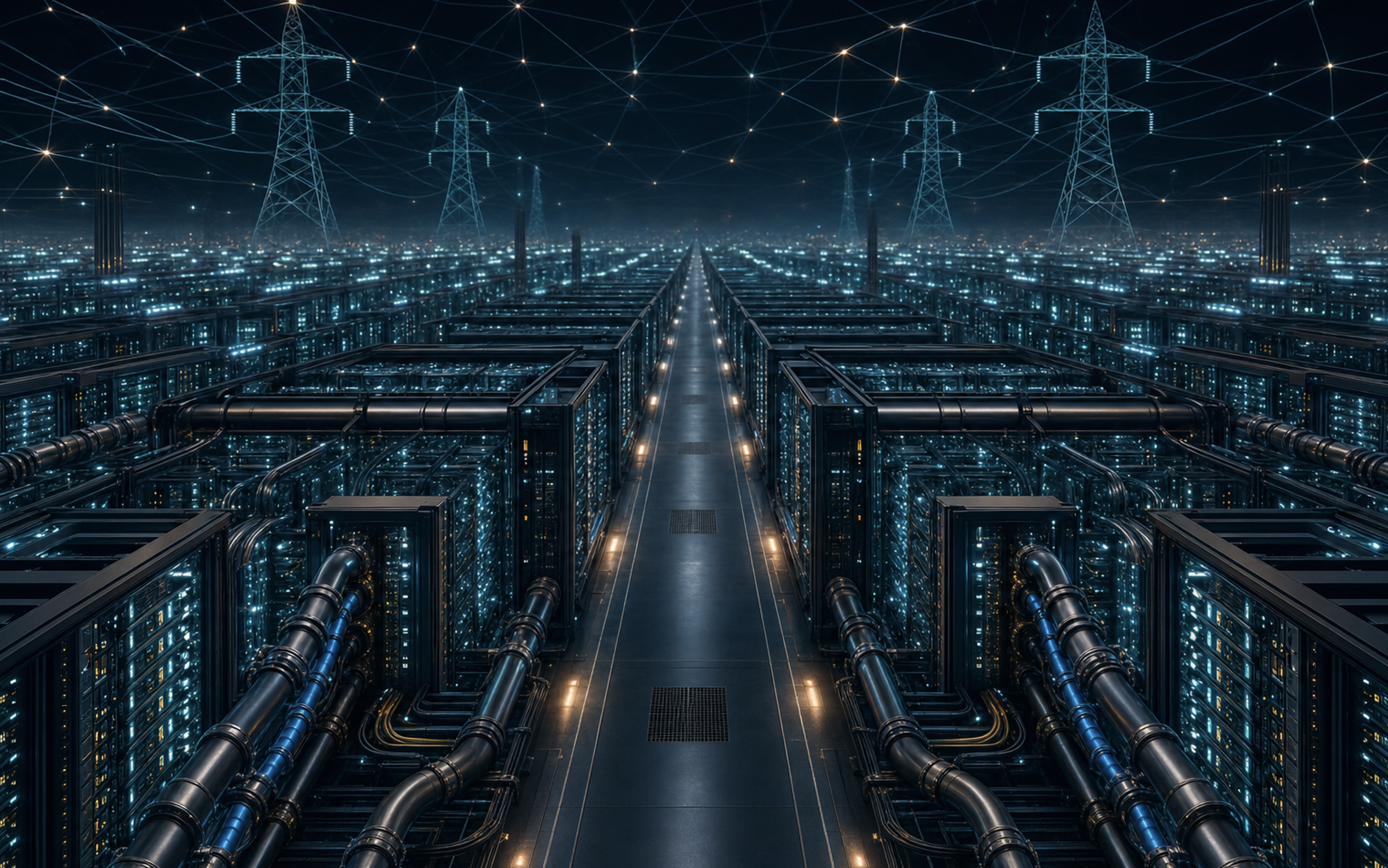
Every so often a single number reframes an entire industry. This month it arrived courtesy of Foxconn chairman Young Liu, who told a business association in Taiwan that building a one-gigawatt AI data centre around NVIDIA’s next-generation Vera Rubin platform would require capital expenditure of as much as $47 billion (Maeil Business). Bernstein Research reached almost exactly the same figure independently, putting the all-in cost at roughly $47.3 billion per gigawatt (Investing.com). When the world’s largest AI server maker and a leading sell-side analyst converge on the same eye-watering number from different directions, it is worth stopping to understand what it actually means — because the figure tells a story not just about cost, but about capital, energy and power that every technology leader should be reading carefully.
Anatomy of a $47 billion building
Start with how the number is built, because the composition matters more than the headline. A single Vera Rubin NVL72 rack is estimated to cost around $9.1 million — well above the $8 million figure that had been circulating in the market (Business Insider). Each rack draws roughly 220 kilowatts. On the assumption that the racks themselves account for about 78% of total facility power, a gigawatt site works out at approximately 3,557 racks (Investing.com).
Do the multiplication and the rack hardware alone comes to roughly $32 billion. Add around $15 billion for the physical infrastructure — the buildings, substations, transformers, mechanical and electrical plant, and cooling — and you arrive at the all-in $47 billion per gigawatt (Investing.com). That is a 17% increase on the roughly $40.5 billion that the previous Blackwell generation commanded (Business Insider). The capital intensity of frontier AI is not plateauing; it is still climbing with each architecture cycle.
It is worth noting the figure sits within a noisy range. Bernstein’s earlier Blackwell-era estimate was around $35 billion, NVIDIA’s own guidance has run to $50–60 billion per gigawatt, and IBM’s chief executive has cited figures as high as $80 billion for a fully equipped facility (Reddit / r-datacenter). The spread reflects different assumptions about redundancy, GPU loading and what you count as “the data centre.” But the direction of travel is unambiguous, and $47 billion is now a defensible central estimate for a Vera Rubin gigawatt.
The counter-intuitive part: power is the cheap but
Here is where the analysis gets genuinely instructive. The annual electricity bill for that one-gigawatt facility is estimated at about $1.3 billion, assuming a fairly high power price of $0.15 per kilowatt-hour (Investing.com). That sounds enormous — and in absolute terms it is — but set against the capital stack it is almost modest. Hardware depreciation, on a six-year asset life, runs to roughly $7.9 billion a year, around six times the power bill (Maeil Business; Investing.com).
That ratio is the single most important takeaway for anyone trying to understand AI economics. The dominant cost of an AI factory is the silicon depreciating on the racks, not the electricity flowing through them. Staffing is almost a rounding error — even the largest sites need only eight to ten employees (Bitget). This is an industry where the asset wears out faster than the building it sits in, and where the financial clock is set by NVIDIA’s product cadence rather than by the grid.
For investors and operators alike, that has a sharp implication. The risk is not primarily that power gets too expensive — though it might. The risk is that a $32 billion stack of accelerators is obsoleted by the next architecture before it has earned its keep. When depreciation dwarfs every other line, utilisation and time-to-revenue become everything.
But energy is where the geopolitics bites
And yet — and this is the GeoTechNexus point — the fact that power is the smaller line item does not make it the smaller problem. Capital can be raised; gigawatts of reliable, dispatchable electricity cannot be conjured on the same timetable. The constraint on the AI build-out is increasingly physical, not financial.
The scale of demand is the issue. One credible projection has global data centre compute rising from 68 gigawatts to 174 gigawatts by 2030, requiring an additional 106 gigawatts of power and implying that roughly 18 gigawatts of new supply must be built every single year between now and the end of the decade (X / The AI Investor). Grid-connection queues already stretch beyond 2030 in many markets, and order books for turbines and generators run out to 2029 (Terakraft). This is precisely why US regulators have begun forcing grid operators to rewrite the rules for connecting large loads — the bottleneck has become a matter of national infrastructure policy.
The industry’s response tells you how serious the constraint is. NVIDIA is partnering to design nuclear-powered AI factories, embedding small modular reactors directly alongside gigawatt-class sites to bypass the grid entirely and eliminate the 15–20% losses of long-distance transmission (Tech Bytes). Vera Rubin itself is engineered around the constraint — fully liquid-cooled, targeting a power usage effectiveness of around 1.02, and delivering roughly ten times the inference throughput per watt of the Blackwell generation (Tech Bytes). Efficiency is improving fast; absolute consumption is rising faster.
What leaders should take from the number
The $47 billion gigawatt is not just a procurement statistic. It is a strategic signal, and it carries three lessons.
First, the barrier to entry has moved out of reach for all but a handful of players. Anyone wanting to deploy top-tier compute at gigawatt scale now needs to put nearly $50 billion of capital expenditure on the balance sheet (Futu). That concentrates the frontier of AI in the hands of a very small number of hyperscalers and sovereign-backed projects — a concentration with its own geopolitical consequences.
Second, the economics only work at high utilisation. With depreciation at roughly six times the power bill, idle silicon is ruinous. The whole edifice depends on inference demand materialising fast enough to fill the racks before the next architecture renders them second-tier. The business case is a bet on demand, not on cost control.
Third, energy security is now technology strategy. The capital is being committed; the open question is whether the electricity, the grid connections and the cooling water can be secured on a comparable timeline. For nations and corporations alike, the ability to power compute is becoming as strategically decisive as the ability to design or manufacture it. The $47 billion buys you the factory. Keeping it running is where the real contest begins.