GeoTechNexus Research Note | Steve Carr | April 2026
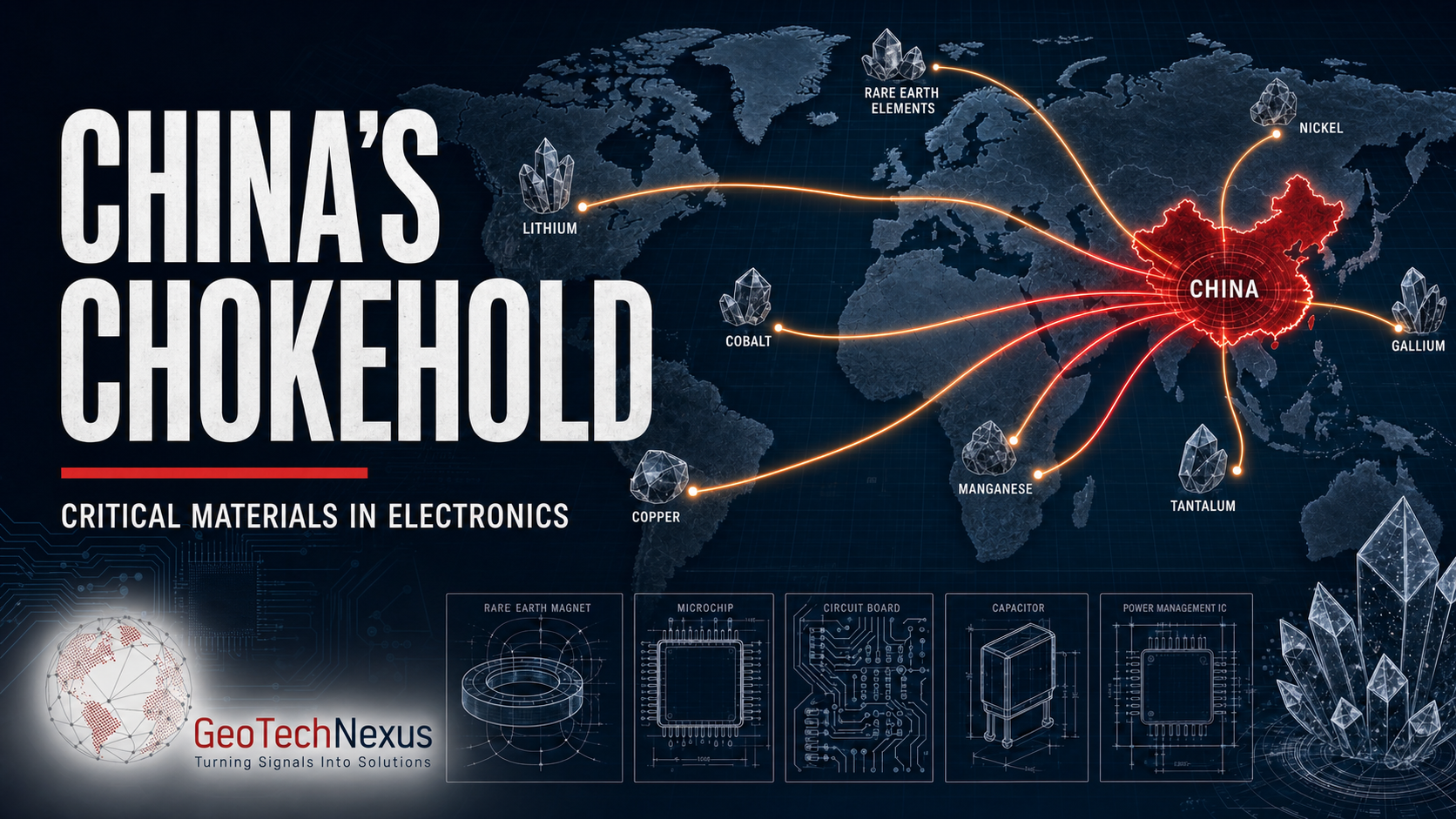
The global electronics and semiconductor industry depends on more than 20 critical materials — rare earth elements (REEs), specialty gases, metals and minerals — whose supply chains are defined by extreme geographic concentration at both the mining and refining stages. This research note maps each material to its specific electronic applications and compounds, quantifies 2024 production by country, and delivers a geopolitical risk assessment calibrated to conditions as of April 2026.
The central finding is a two-layer vulnerability: raw material mining is already heavily concentrated, but China’s near-total dominance of downstream refining and processing represents the deeper and more intractable chokepoint. China controls approximately 69% of rare earth mining and ~85% of global refining; ~94% of gallium supply; ~82–83% of germanium; ~83–85% of tungsten; and ~90%+ of battery-grade graphite processing. Critically, China has moved from passive supply dominance to active weaponisation — imposing sequential export controls on gallium and germanium (August 2023), graphite (December 2023), tungsten (February 2025), and heavy rare earth elements (ongoing). A separate acute crisis has emerged in the helium market, where Qatari supply disruption linked to the Iran conflict and the dismantling of the US Federal Helium Reserve have caused spot prices to spike 70–100%, directly threatening semiconductor fabrication.
Beyond China, tantalum and cobalt face extreme risk from active conflict zones in eastern DRC, where M23 rebel control of key mines and widespread artisanal mining create both compliance and continuity exposure under the EU Conflict Minerals Regulation and US Dodd-Frank Act Section 1502. Achieving meaningful supply chain resilience requires simultaneous action on alternative sourcing and Western refining capacity investment, with realistic timelines of 5–10 years. Near-term priorities include helium conservation, qualification of conflict-free tantalum sources, and accelerated R&D into material substitution.