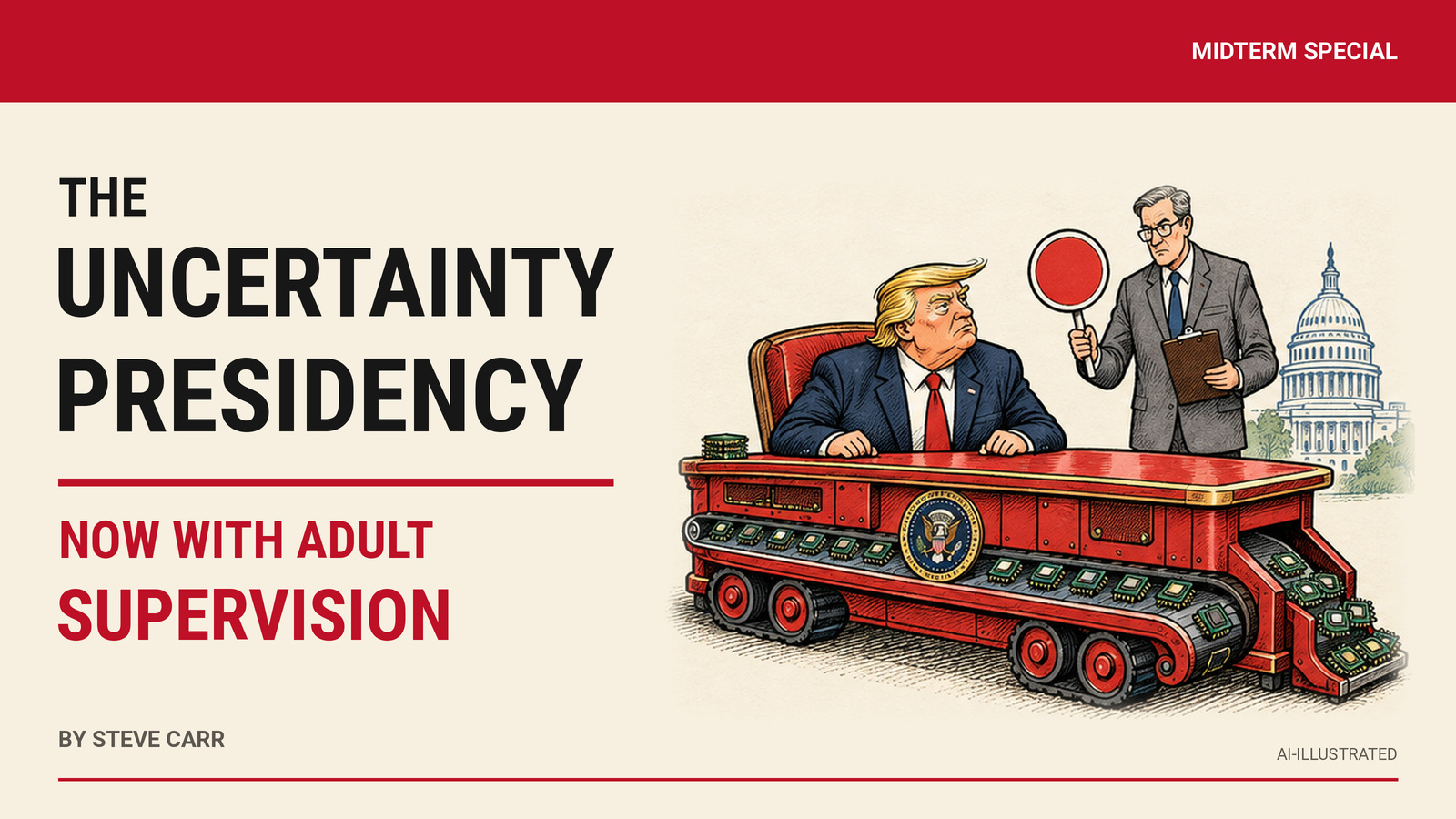
America voted for a congressional brake. Tech should not mistake it for a factory reset.
The 2026 midterm results have delivered a new complication for Donald Trump: an incoming opposition Congress, with the Associated Press calling both the House and Senate for Democrats and CNN projecting the same outcome. (Associated Press, CNN) For technology executives hoping this means Washington has uninstalled uncertainty, a small warning: the operating system is still running. It is merely about to acquire a second administrator, and the administrators do not share a password.
The voters have requested a manager
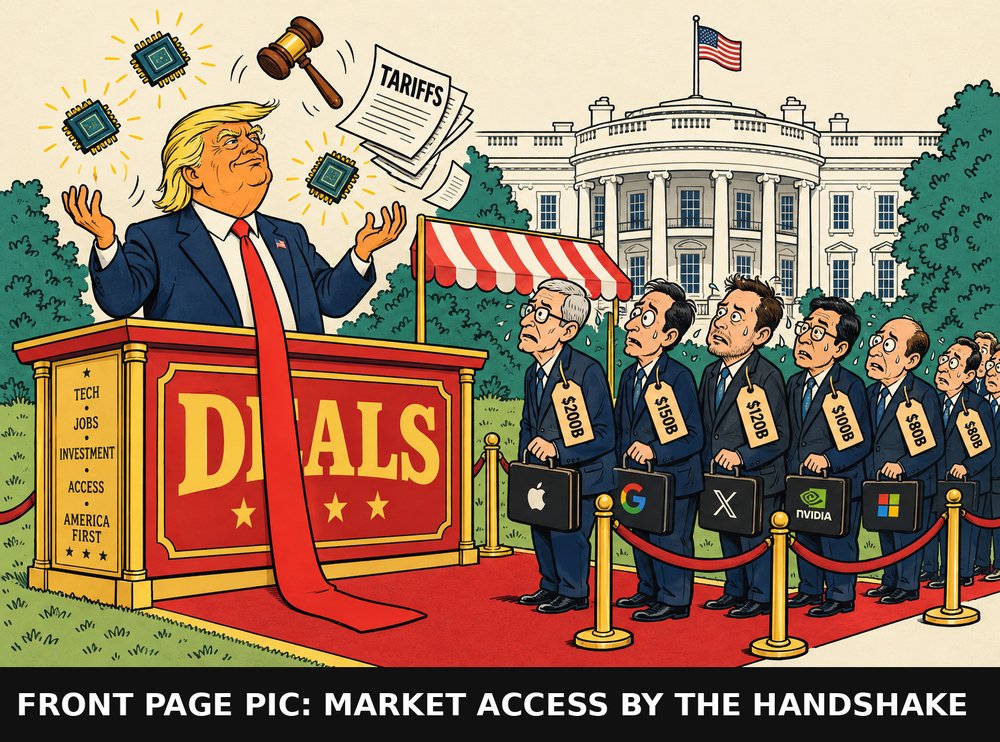
In The Uncertainty Presidency, the argument was that technology companies had allowed predictable rules to give way to political bargaining, then mistaken their individual accommodations for a functioning business environment. The piece called for common rules rather than a longer queue for special treatment. The appropriate sequel is not a victory lap. It is a check on whether anyone has learned anything.

AP reports that Democrats flipped at least seven Republican Senate seats, including Texas, Iowa and Kansas, while also winning control of the House. (Associated Press) This was not the electoral equivalent of a politely worded customer survey. It was a request to speak to the manager, followed by the discovery that the manager was also on the ballot.
The result should not, however, be repackaged as a national instruction to restore frictionless semiconductor trade. AP’s voter polling points to frustration over costs and a desire for stronger checks on the president, while also warning that many voters remain unhappy with Democrats. (Associated Press) A vote to install a fire alarm is not an endorsement of everything the fire brigade might subsequently propose.
A vote to install a fire alarm is not an endorsement of everything the fire brigade might subsequently propose.
A congressional brake is not a factory reset
The incoming Democratic majorities will be able to obstruct Trump’s legislative agenda, scrutinize his administration and, in the Senate, reject nominees. (Associated Press) That is a material change in the balance of power. It is not a presidential replacement, a customs refund or a complimentary export license.
Congress holds the constitutional power over tariffs but has delegated substantial authority to the executive through trade statutes, including Sections 232 and 301. (Congressional Research Service) An election changes the people holding congressional office. It does not, by itself, edit the statutes they inherit.
An election changes the people holding congressional office. It does not, by itself, edit the statutes they inherit.
As Patrick Leblond argued before the vote, attempts to change or repeal the administration’s tariff authorities would still face the president’s veto. (Chicago Council on Global Affairs) The distinction is worth explaining to any board already asking procurement when the good old days will be delivered. Preferably before somebody promises a lower landed cost in next year’s budget.
My base case is therefore not an immediate return to predictable trade. It is a period in which executive action faces more congressional resistance, and businesses must distinguish a genuine legal change from a louder argument about one.

Your exemption may need an explanation
CNN reports that incoming Democratic committee leaders are preparing for a new round of investigations, with subpoena powers becoming available once the new Congress is seated. (CNN) The White House meeting may no longer be the end of a company’s Washington story. There could also be a committee invitation, less flattering lighting and a request to explain the paperwork.
That does not mean a particular technology company has done anything wrong, or that every corporate agreement will become an investigation. It means boards should prepare for the possibility that arrangements defended privately as commercial pragmatism may need to be explained publicly as sound governance.
The sensible response is neither panic nor an emergency order for bipartisan lapel pins. It is a review of the decisions a company could defend if an unusually skeptical audience were allowed to ask follow-up questions.
There are limits to the new oversight, too: CNN notes potential obstacles to enforcing congressional subpoenas against an administration resistant to disclosure. (CNN) Supervision is not the same as control. Washington can generate a considerable volume of accountability theater before anyone produces the missing attachment.
Beijing has not been voted off the supply chain
Any assumption that Democratic control of Congress means an automatic softening of semiconductor restrictions should meet the bipartisan MATCH Act proposal. (Office of Representative Michael Baumgartner) Introduced earlier this year with Republican and Democratic support, it seeks tighter controls on semiconductor manufacturing equipment and closer alignment with allied restrictions. (Office of Representative Michael Baumgartner) Bipartisanship, it turns out, can also mean two parties agreeing to make your compliance department larger.
That proposal is evidence of cross-party appetite for tighter controls, not proof of what the incoming Congress will enact. Nor does criticism of Trump’s methods necessarily imply support for unrestricted technology sales to China.
The commercial planning assumption should therefore remain cautious: a different congressional majority is not a dependable proxy for easier market access. A company that wants to serve several major markets should test how it would operate under continued restrictions, rather than book the benefits of a diplomatic thaw that nobody has delivered.
There may be opportunities for better coordination with allies and clearer rules. Those are outcomes worth pursuing, not accessories automatically included with a new committee chair.

Meanwhile, the hardware still has to ship
The tariff machinery was operating before election night. CRS’s October 8 fact sheet, covering actions as of September 30, recorded Section 301 duties affecting 60 economies and Section 232 measures covering certain semiconductors, alongside investigations involving robotics and industrial machinery. (Congressional Research Service) A victory speech is not an amendment to that machinery.
For an IoT supplier, the useful question is not whether Washington feels more reassuring this morning. It is which components and finished products are covered by which rules, where they cross borders, and what the business would do if the treatment changed.
Consider an industrial gateway assembled in one country, incorporating components from several others and sold into the United States. Its commercial exposure needs to be assessed through the applicable classifications, origins and transaction details, not the political color of an election map.
For planning purposes, treat a tariff reduction as unconfirmed until the relevant legal action is issued. Treat an alternative component as unavailable until the engineering and commercial teams have established that it is usable. This is less exciting than election-night graphics, but considerably more useful when a customer asks whether the order will arrive.
A victory speech is not an amendment to the tariff machinery.
Five things tech could do besides refreshing the results
- Reprice the actual exposure: Review affected products and routes using the rules that apply, not an assumed post-election discount. Keep hoped-for relief separate from the operating budget.
- Audit the political dependencies: Identify revenue, investments or sourcing plans that depend on discretionary treatment. Ask whether each arrangement remains defensible if the audience changes.
- Prepare the evidence: Keep a clear record of why major location, investment and market-access decisions were made. A photograph with a politician is not a business case, even when printed on expensive paper.
- Ask for rules that competitors can use too: Make the case for clear criteria, published processes and workable transition periods. A stable framework is more valuable than an exemption whose principal qualification is having the correct phone number.
- Test a prolonged standoff: Model a situation in which political resistance increases but the commercial restrictions do not quickly disappear. If the plan only works after Washington becomes sensible, it is not yet a resilience plan.
None of this requires predicting every argument in the next Congress. It requires refusing to let a preferred political outcome substitute for an operating strategy.

The Democrats have won an opportunity, not a competence certificate
The opposition now has its own test: whether it can turn scrutiny into something more useful than footage. It would be a disappointing outcome if technology policy became marginally more accountable but no easier to understand.
The industry’s request should be practical. Define the security objective, explain the legal mechanism, make the compliance route usable and give businesses a credible basis for investment decisions.
That does not require pretending all technology trade is harmless. It requires distinguishing a targeted restriction with a clear purpose from an endlessly changing collection of commercial surprises.
Executives should apply the same standard to both parties. Predictability is not a partisan favor; it is something companies should be able to demand without first buying a ticket to the correct fundraising dinner.
New supervisor, same uncertainty
The immediate electoral conclusion is clear: Democrats have won control of both chambers, although some races remain unresolved and official certification follows later. (Associated Press) The commercial conclusion is narrower: businesses should prepare for a different balance of power, not assume that existing trade restrictions have expired.
The opportunity is real. Stronger scrutiny could make arbitrary arrangements harder to defend and create pressure for more durable rules.
But that is a possibility to work toward, not a saving to recognize today. Technology companies should welcome the prospect of checks and balances while continuing to check the bill of materials.
The uncertainty presidency has acquired a supervisor. Procurement should keep the contingency plan.
EDITORIAL NOTE: Reporting checked November 4, 2026. Refresh election calls and any intervening policy announcements before publication.