Everyone worries about who mines critical minerals. The real single point of failure is who refines them — and China controls around 90% of rare earth processing and 98% of refined gallium. Steve Carr argues the midstream, not the mine, is where the chokehold truly bites.
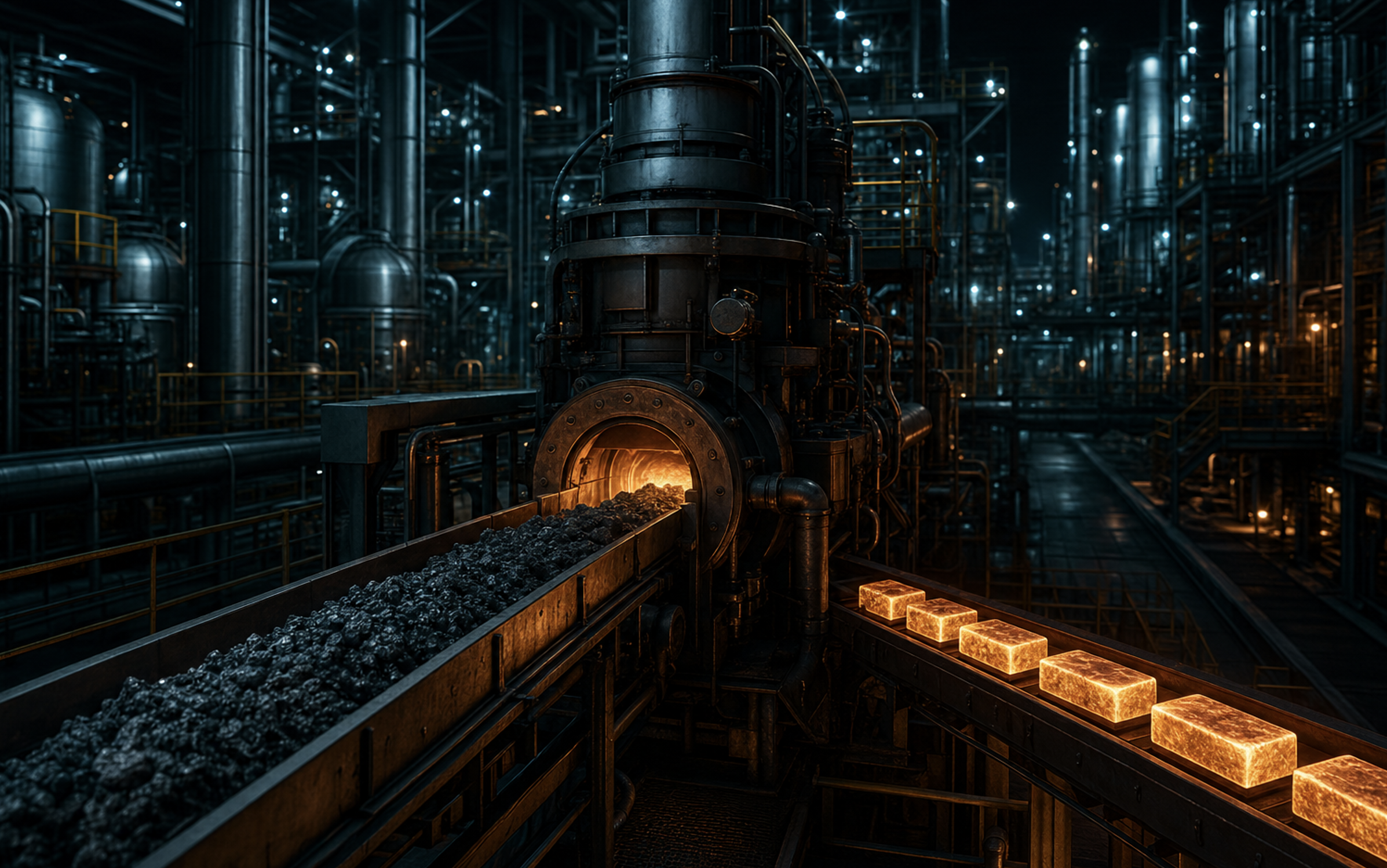
When our “China’s Chokehold” report mapped the concentration of critical materials earlier this year, the data point that drew the most attention from readers was the mining figure — the share of rare earths and strategic metals pulled out of Chinese ground. It is an arresting number, and it is also, I have come to believe, the wrong number to fixate on. The more I have worked through the supply chains since, the clearer it has become that mining is the part of the problem most amenable to a fix, and therefore the least dangerous. The genuine single point of failure sits one step downstream, in the refineries, separation plants and chemical-conversion lines that turn ore into something a factory can actually use. This is the midstream, and it is where the chokehold truly bites.
The numbers tell a lopsided story
Consider the gap between mining and refining in rare earths. China mines roughly 60% to 70% of the world’s rare earths — a commanding share, certainly, but one that other nations are steadily eroding as new mines open in Australia, the United States and Africa. Now look at refining. China controls approximately 90% of global rare earth processing and separation capacity, with the International Energy Agency putting the 2024 figure at 91.7%.
The asymmetry widens the further down the chain you look. For the heavy rare earths that matter most to defence and high-performance magnets — dysprosium and terbium — China’s processing share rises to between 98% and 99%. It refines around 92% of the world’s NdPr, the neodymium-praseodymium feedstock for permanent magnets, and manufactures roughly 94% of the magnets themselves. The pattern repeats across the critical-minerals board: roughly 73% of cobalt refining, around 68% of nickel, some 95% of graphite processing — all run through Chinese facilities.
Overall, China holds about 70% of global critical-mineral refining capacity. The mine is contestable. The refinery, on current evidence, is not.
Gallium and germanium: the asymmetry made visible
If you want a single, clean illustration of why refining is the real chokepoint, look at gallium and germanium — the two semiconductor materials China placed under export licensing in July 2023, of which it produces around 98% of the world’s refined supply. But the two metals behave very differently once you understand where the bottleneck actually sits, and that difference is the whole argument of this piece.
Gallium is the harder problem. China’s stranglehold on refined, high-purity gallium runs to around 98%, and crucially, the downstream inputs — gallium compounds, semiconductor wafers — remain almost entirely dependent on feedstock that originates in China even when the final processing happens elsewhere. When export curbs bite, the regional price spread for gallium blows out, because there is simply no established alternative refining route to absorb the shock.
Germanium tells the opposite story, and it is instructive. China’s share of refined germanium is lower — variously estimated at 60% to 83% — and, more importantly, secondary recovery from optical-fibre and electronic scrap is well established outside China. The consequence is measurable: when controls hit, the germanium price spread is far tighter, at roughly 8% to 12%, precisely because alternative refining and recovery routes exist.
Same exporter, same announcement, two completely different vulnerability profiles — and the variable that explains the difference is not how much of each metal China mines. It is whether a credible refining alternative exists outside its borders. That is the chokepoint, isolated and made visible.
Why the midstream is so much harder to fix than the mine
The instinctive policy response to material dependence is to open a mine. It is visible, it is politically satisfying, and it generates jobs. It also largely misses the point. As a 2024 UN analysis confirmed, refining, processing and recycling — not mining — are the real bottlenecks in critical-minerals supply. You can mine ore in Australia, South America or Africa and still find that the value chain — separation, chemical conversion, advanced materials — runs back through a handful of industrial hubs, most of them Chinese.
Three things make the refinery far harder to replicate than the mine. First, it is a function of cost structure, not geology. Japanese officials describe China’s “almost 100% competitive edge” in medium and heavy rare-earth refining as driven by cost factors that are structural rather than temporary. A Western refiner can be built, but it will struggle to compete on price the moment Beijing chooses to flood the market — exactly as happened in copper, where a surge of Chinese-backed capacity pushed refining margins negative.
Second, it is the product of thirty years of deliberate industrial policy, accumulated process know-how and tolerated environmental cost that cannot be compressed into a single planning cycle. Separation chemistry for heavy rare earths in particular is a hard-won capability, not a turnkey purchase.
Third, the position is deepening, not eroding. A 2026 Griffith Asia Institute study found China’s processing dominance to be strategic, durable and still strengthening. Even the IEA’s relatively optimistic projection has China still holding around 76% of rare-earth refining in 2030 and 75.7% in 2040 — a softening of dominance, not an end to it.
What technology leaders should actually do
The strategic conclusion is not despair; it is a reallocation of attention. If you are assessing your exposure to critical-materials risk, stop scoring your supply chain on where the ore comes from and start scoring it on where the refining happens. A diversified mining base feeding a single-country refinery is not diversified at all — it is a single point of failure with extra steps.
In practice that means three things. Map your bills of materials to refined-input dependency, not mined-origin dependency, and flag any input where credible non-Chinese refining capacity does not exist — your gallium-type exposures, not your germanium-type ones. Favour, where you can, materials and designs that have an established secondary-recovery or alternative-processing route, because that is what determines whether a price spike is a 10% inconvenience or a 200% crisis. And when you evaluate the wave of Western reshoring announcements, ask the hard question: is this a mine, or is it a refinery? Because the mines will get built, and they will not save you. The contest that matters — the one that will define critical-materials security for the next decade — is being fought in the midstream, and it is the part almost everyone is still underestimating.