By Bolaji Ojo
Principal Analyst, Geotechnexus
Abstract
The semiconductor industry is undergoing a structural transformation that is redefining the logic of its traditional boom–bust cycle. Rather than being driven solely by demand fluctuations, inventory corrections, and capital expenditure cycles, the industry is increasingly shaped by geopolitical forces, including export controls, industrial policy, and defense-driven demand.
This article introduces two analytical constructs — Politically Exposed Revenue (PER) and the Geopolitical Turbulence Index (GTI) — to explain how policy intervention is reshaping revenue patterns, supply chains, and investment decisions. Through case studies of leading companies such as Nvidia, TSMC, Micron, and ASML, it demonstrates how pre-restriction stockpiling, product segmentation, regionalized manufacturing, and chokepoint control are altering the structure of the global semiconductor system.
The analysis argues that the industry is not simply becoming more volatile, but is transitioning into a new “geopolitical cycle,” in which state priorities, security considerations, and strategic competition increasingly determine market outcomes. This shift has profound implications for corporate strategy, capital allocation, and investor decision-making, requiring new frameworks to assess risk and opportunity in a policy-driven environment.
Top 5 Strategic Takeaways
- The semiconductor cycle is not ending — it is being redefined by geopolitics.
Policy decisions now shape demand, supply, and capital allocation alongside traditional market forces. - Revenue is becoming politically exposed.
Companies increasingly derive growth — and face risk — based on access to markets defined by geopolitical alignment rather than purely commercial demand. - A new “geopolitical cycle” is emerging.
Export controls, industrial policy, and defense spending now create demand shocks and supply distortions that overlay and reshape traditional boom–bust dynamics. - Technology and markets are fragmenting.
Firms are designing region-specific products, building redundant supply chains, and operating across segmented ecosystems defined by policy constraints. - Competitive advantage now includes geopolitical positioning.
Success depends not only on technology and scale, but on alignment with policy ecosystems, supply chain resilience, and strategic access.
Executive Summary
The electronics industry is witnessing the birth and emergence of a structurally different semiconductor system, where political exposure, national strategy, and defense priorities increasingly override traditional market signals.
Until now and for decades, the semiconductor industry operated within a relatively predictable boom-bust cycle, typically oscillating every 3 to 4 years. These cycles were driven by synchronized demand surges (PCs, smartphones, servers), inventory corrections, and capital expenditure overreach.
The cycle became a defining characteristic of the industry. Analysts tracked it, executives planned around it, and investors internalized it as a structural inevitability. It was not stable, but it was predictable.
That predictability is now breaking.
What is emerging in its place is not simply a more volatile version of the old system, but something fundamentally different: a semiconductor industry increasingly governed not by market signals, but by geopolitical logic. Over the past eight years, and especially since 2018, governments have moved from peripheral influence to central actors in determining how chips are designed, manufactured, distributed, and ultimately consumed.
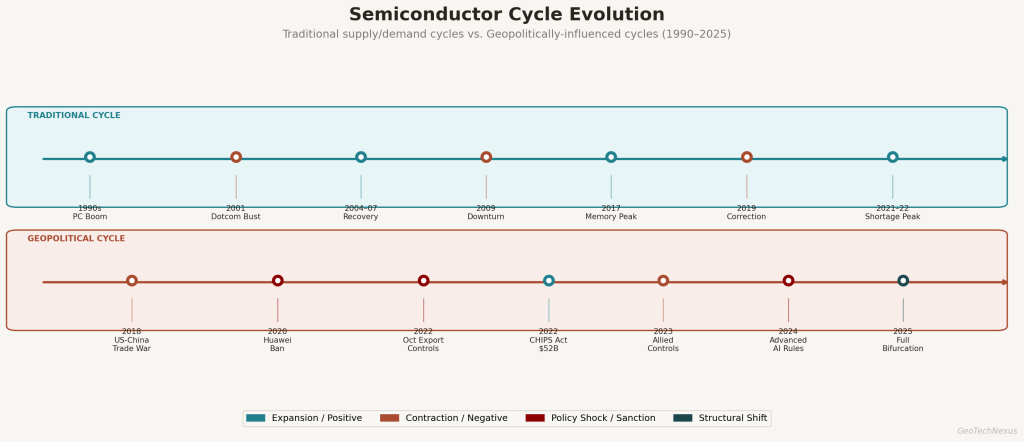
The result is the gradual dismantling of the traditional semiconductor cycle and its replacement by a system defined by policy intervention, sovereign priorities, and strategic competition.
This transformation is not theoretical. It is already visible in revenue patterns, supply chain configurations, capital allocation decisions, and demand formation across the industry. To understand what is happening and more importantly, what comes next, it is necessary to reframe the semiconductor industry through a different analytical lens.
At GeoTechNexus, this lens is built on two core constructs: Politically Exposed Revenue (PER) and the Geopolitical Turbulence Index (GTI). Together, they provide a framework for understanding how geopolitical forces are reshaping the economic logic of semiconductors.
From Market Cycle to Policy System
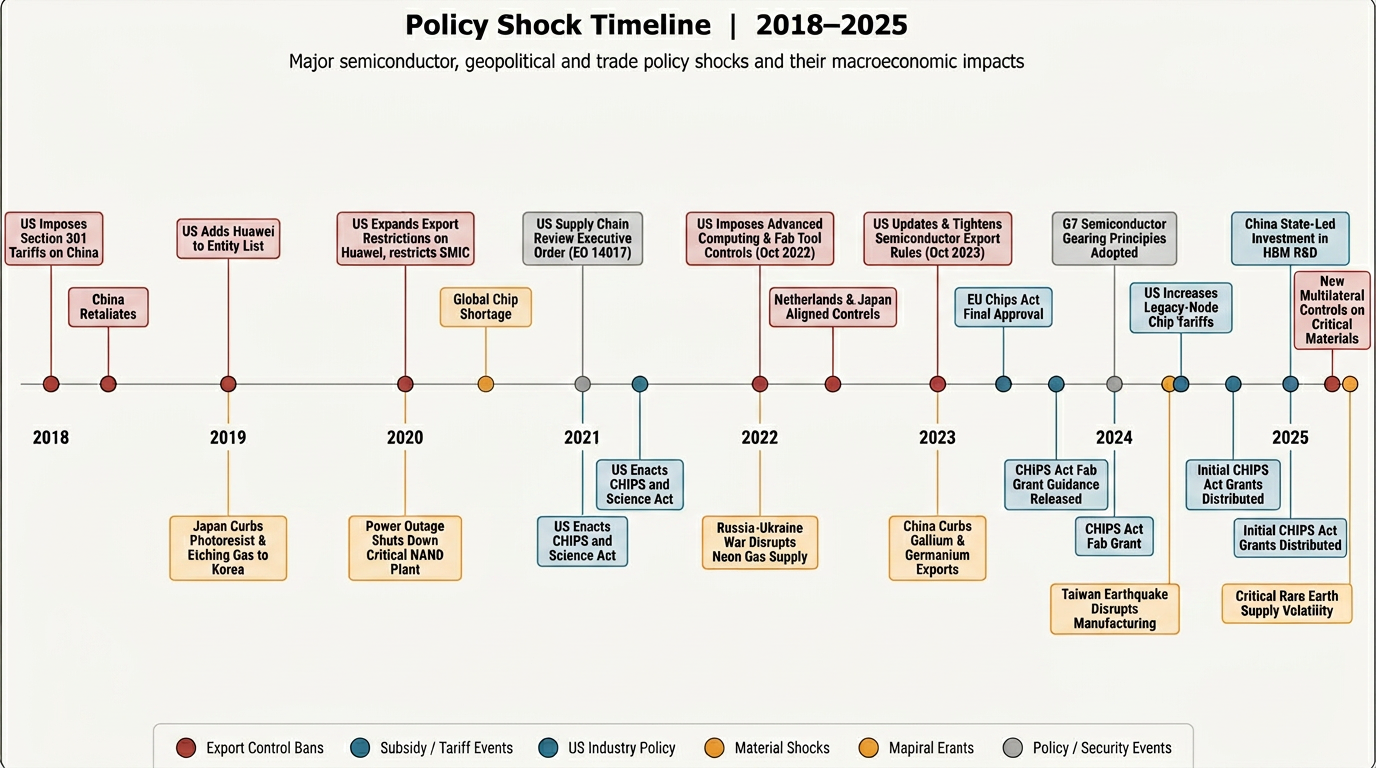
The turning point for the semiconductor industry did not arrive with a single event. Rather, it emerged through a series of policy actions that collectively redefined the boundaries of the market.
Beginning around 2018, the United States initiated a series of export controls and entity listings targeting Chinese technology companies. These measures were not restricted to specific firms; they extended to entire categories of technology, including advanced processors, AI accelerators, and semiconductor manufacturing equipment.
What distinguished these actions from earlier trade disputes was their structural intent. They were not designed merely to correct trade imbalances or address intellectual property concerns. They were aimed at shaping the technological trajectory of a geopolitical competitor. In doing so, they transformed semiconductors from a commercial product into a strategic asset.
China responded in kind, accelerating its efforts to build domestic semiconductor capabilities. Massive state-backed investments flowed into design, manufacturing, equipment, and materials. At the same time, Europe, Japan, South Korea, and other regions launched their own initiatives to secure supply chains and reduce dependence on external sources. The United States passed the CHIPS and Science Act, committing tens of billions of dollars to domestic semiconductor manufacturing and research.
These actions collectively marked the transition from a market-driven system to a policy-driven system. In the traditional model, supply and demand were the primary determinants of industry behavior. In the emerging model, access rights — defined by governments — play an equally, if not more, significant role. Who can buy a chip, who can manufacture it, and where it can be shipped are increasingly determined by regulatory frameworks rather than market dynamics.
This shift has profound implications. It means that demand is no longer purely a function of end-market needs. It can be created, redirected, or suppressed by policy decisions. Similarly, supply is no longer solely a function of capacity and technology. It can be constrained or expanded by geopolitical considerations.
Revenue in the Age of Political Exposure
One of the most immediate effects of this transformation has been the distortion of revenue patterns across the semiconductor industry. Over the past five years, the financial performance of major semiconductor companies has increasingly reflected geopolitical forces.
Consider the phenomenon of “pre-restriction demand.” When export controls are anticipated, customers rush to secure supply before restrictions take effect. This creates artificial demand spikes that are not tied to underlying consumption. Once the restrictions are implemented, demand collapses, leading to sharp revenue declines. The result is a pattern of volatility that is not cyclical in the traditional sense, but policy-induced.
This dynamic has been particularly evident in segments with significant exposure to China. Memory manufacturers, for example, have experienced pronounced swings as Chinese customers stockpiled components ahead of restrictions and then reduced purchases afterward. Equipment suppliers have seen similar effects, with order patterns influenced by regulatory timelines rather than production needs.
At the same time, companies aligned with policy-supported ecosystems have benefited from sustained demand. Advanced logic providers, particularly those supplying AI-related chips, have seen robust growth driven by both commercial demand and government-backed initiatives. Foundries and equipment manufacturers have benefited from subsidies and incentives tied to domestic capacity expansion.
These divergent outcomes highlight the importance of Politically Exposed Revenue (PER) as a metric. PER captures the extent to which a company’s revenue is influenced by geopolitical factors. A high PER score indicates significant exposure to policy-driven risks and opportunities. Companies with high PER may experience greater volatility, but they may also benefit from policy tailwinds. Conversely, companies with low PER may operate in more stable markets, but they may also face limitations on growth if they are excluded from key regions or technologies.
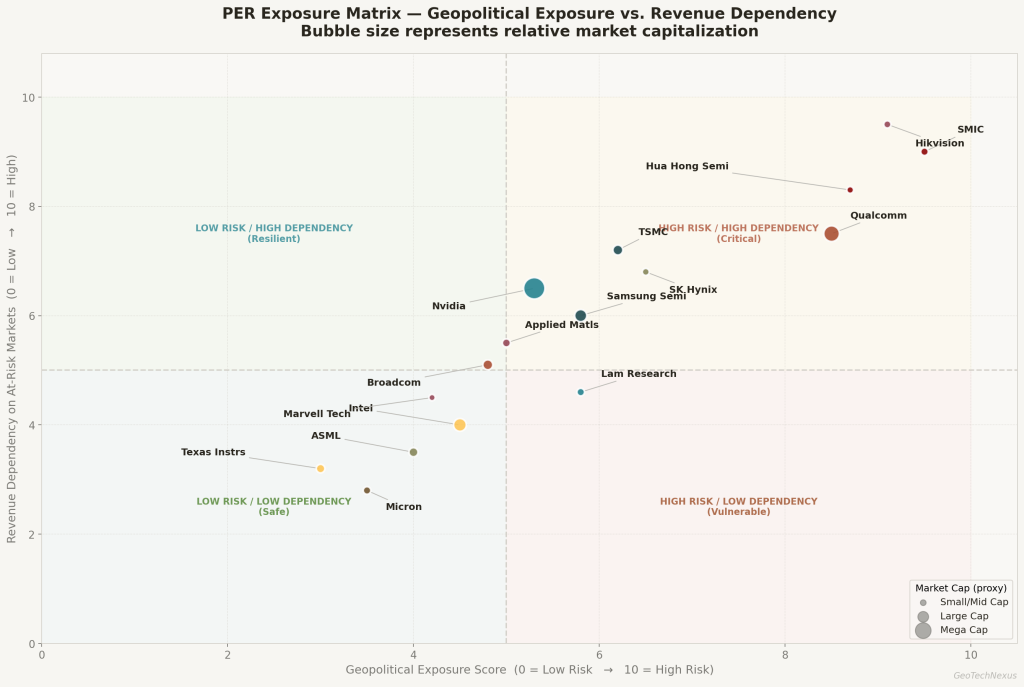
What is emerging is a new form of revenue logic. Growth is no longer determined solely by market share and technological leadership. It is also shaped by alignment with geopolitical priorities. Companies must now navigate not only competitive dynamics, but also rapidly evolving regulatory landscapes.
Case Study: Nvidia and the Segmentation of Innovation
The transformation of Nvidia over the past five years provides a clear illustration of these dynamics. The company’s rise has been driven by the explosive growth of AI, which has created unprecedented demand for high-performance computing. However, this demand has been shaped — and constrained — by export controls targeting China.
In response, Nvidia has adopted a strategy of product segmentation. High-end GPUs are restricted, while modified versions are developed for markets subject to regulatory constraints. This approach allows the company to maintain a presence in restricted markets while complying with export regulations.
This segmentation is more than a tactical adjustment. It represents a structural shift in how technology is developed and distributed. Instead of a single global product, companies are increasingly designing multiple versions tailored to different regulatory environments. This has implications for cost structures, innovation cycles, and competitive dynamics.
At the same time, Nvidia’s growth has been supported by demand from government-funded initiatives, particularly in the United States and allied countries. AI has become a strategic priority, with applications spanning defense, intelligence, and critical infrastructure. This has created a form of demand that is less sensitive to economic cycles and more aligned with long-term policy objectives.
TSMC and the Geography of Trust
If Nvidia represents the demand side of the transformation, TSMC represents the supply side. As the world’s leading advanced semiconductor manufacturer, TSMC occupies a central position in the global supply chain. Its facilities in Taiwan have long been a cornerstone of the industry’s efficiency and scale.
However, this concentration has also become a source of geopolitical risk. Concerns about the security of supply have prompted efforts to diversify manufacturing locations. TSMC’s investments in the United States and Japan are part of a broader trend toward regionalization.
This shift is not driven by cost efficiency. In many cases, producing chips outside of Taiwan is more expensive. Instead, it is driven by the need to ensure supply continuity in the face of geopolitical uncertainty. Governments are willing to subsidize these investments because the strategic value of secure supply outweighs the economic costs.
The result is a reconfiguration of the supply chain. Instead of a globally optimized network, the industry is moving toward a more fragmented system with multiple regional hubs. This reduces efficiency, but it increases resilience. It also creates new dynamics in terms of capacity utilization, pricing, and competition.
Micron and the Amplification of Cycles
The memory segment provides a particularly clear example of how geopolitics is amplifying traditional cycles. Memory has always been one of the most volatile segments of the semiconductor industry, with prices and demand fluctuating significantly over time.
In recent years, this volatility has been exacerbated by geopolitical factors. Restrictions on Chinese companies have altered demand patterns, while domestic initiatives in China have created new sources of competition. At the same time, global demand has been influenced by policy-driven investments in AI and data infrastructure.
For companies like Micron, this has resulted in a complex interplay of forces. Traditional supply-demand dynamics are still present, but they are overlaid with policy-driven disruptions. This makes it more difficult to anticipate cycles and manage capacity.
ASML and the Power of Chokepoints
Another striking example of geopolitical influence is the role of ASML. As the sole provider of EUV lithography equipment, ASML occupies a unique position in the semiconductor ecosystem. Its technology is essential for producing the most advanced chips.
Recognizing this, governments have imposed restrictions on the export of ASML’s equipment to certain countries. This effectively limits the ability of those countries to develop advanced semiconductor capabilities.
This dynamic illustrates the concept of “chokepoints” — critical technologies or components that can be used to exert control over the broader system. By controlling access to these chokepoints, governments can shape the trajectory of the industry.
Defense Demand and the New Hierarchy of Access
One of the most significant though underappreciated developments in the semiconductor industry is the rise of defense-driven demand. As global tensions increase, governments are investing heavily in military capabilities that rely on advanced electronics.
This includes everything from autonomous drones and advanced fighter jets to secure communications and cyber defense systems. All these systems require semiconductors, often with specific performance and reliability characteristics.
As defense demand grows, it creates a new hierarchy of access. Governments must prioritize supply for military and strategic applications. This can lead to situations where commercial buyers face constraints, even in the absence of overall shortages. This dynamic introduces a new layer of complexity to the industry. It means that availability is not solely determined by production capacity. It is also influenced by allocation decisions that reflect national priorities.
The Emergence of a Geopolitical Cycle
Taken together, these developments point to the emergence of a new type of cycle. Unlike the traditional semiconductor cycle, which was driven by economic factors, the emerging cycle is shaped by geopolitical forces.
This geopolitical cycle is characterized by:
- Policy shocks that can rapidly alter market conditions
- Defense and State-driven demand that provides a baseline level of activity
- Fragmented supply chains that reduce synchronization across regions
- Strategic investments that create capacity independent of immediate demand
This does not mean that economic cycles have disappeared. Rather, they have been overlaid with a new set of drivers that can amplify, dampen, or redirect traditional patterns.
GTI: Linking Turbulence to Market Behavior
The GeoTechNexus Geopolitical Turbulence Index (GTI) provides a way to quantify these effects. By tracking indicators such as policy actions, trade restrictions, and defense spending, the GTI offers a measure of the level of geopolitical disruption.
When GTI levels are high, the semiconductor industry is more likely to experience volatility. Demand may be distorted by stockpiling or restrictions, while supply may be constrained by regulatory barriers. Conversely, periods of lower turbulence may allow for more stable market conditions.
By integrating GTI with PER, it becomes possible to map how different companies are affected by geopolitical forces. Companies with high PER and high GTI sensitivity are likely to experience the greatest volatility, while those with lower exposure may be more insulated.
A Structural Reset, Not a Temporary Disruption
It is tempting to view these developments as temporary disruptions that will eventually subside. However, the evidence suggests that we are witnessing a structural reset.
The forces driving this transformation — strategic competition, technological rivalry, and national security concerns — are unlikely to diminish in the near term. If anything, they are likely to intensify.
This has important implications for how the semiconductor industry evolves. The traditional model of global integration and efficiency is being replaced by a more complex system characterized by fragmentation and redundancy. While this may reduce efficiency, it increases resilience and aligns with strategic priorities.
Conclusion: Redefining the Logic of the Industry
The semiconductor industry is entering a new phase in its evolution. The familiar patterns of the past are giving way to a system shaped by geopolitics, policy, and strategic competition.
For companies, this requires a fundamental shift in thinking. Success will depend not only on technological leadership and operational efficiency, but also on the ability to navigate a complex and evolving geopolitical landscape.
For investors and policymakers, it requires new tools and frameworks to understand and anticipate changes. PER and GTI provide a starting point, but they must be integrated into broader analytical approaches.
Ultimately, the semiconductor cycle has not disappeared. Rather, it has been transformed. It is no longer a purely economic phenomenon, but now a reflection of the geopolitical forces that are reshaping the global economy.
Bolaji Ojo is principal analyst at Geotechnexus. Contact him at bojo@geotechnexus.com.