The global technology industry once operated on a simple assumption: the best product wins. Whoever built the fastest chip, the most capable AI model, or the most reliable network infrastructure would dominate the market — regardless of where they were based. That assumption is now dead.
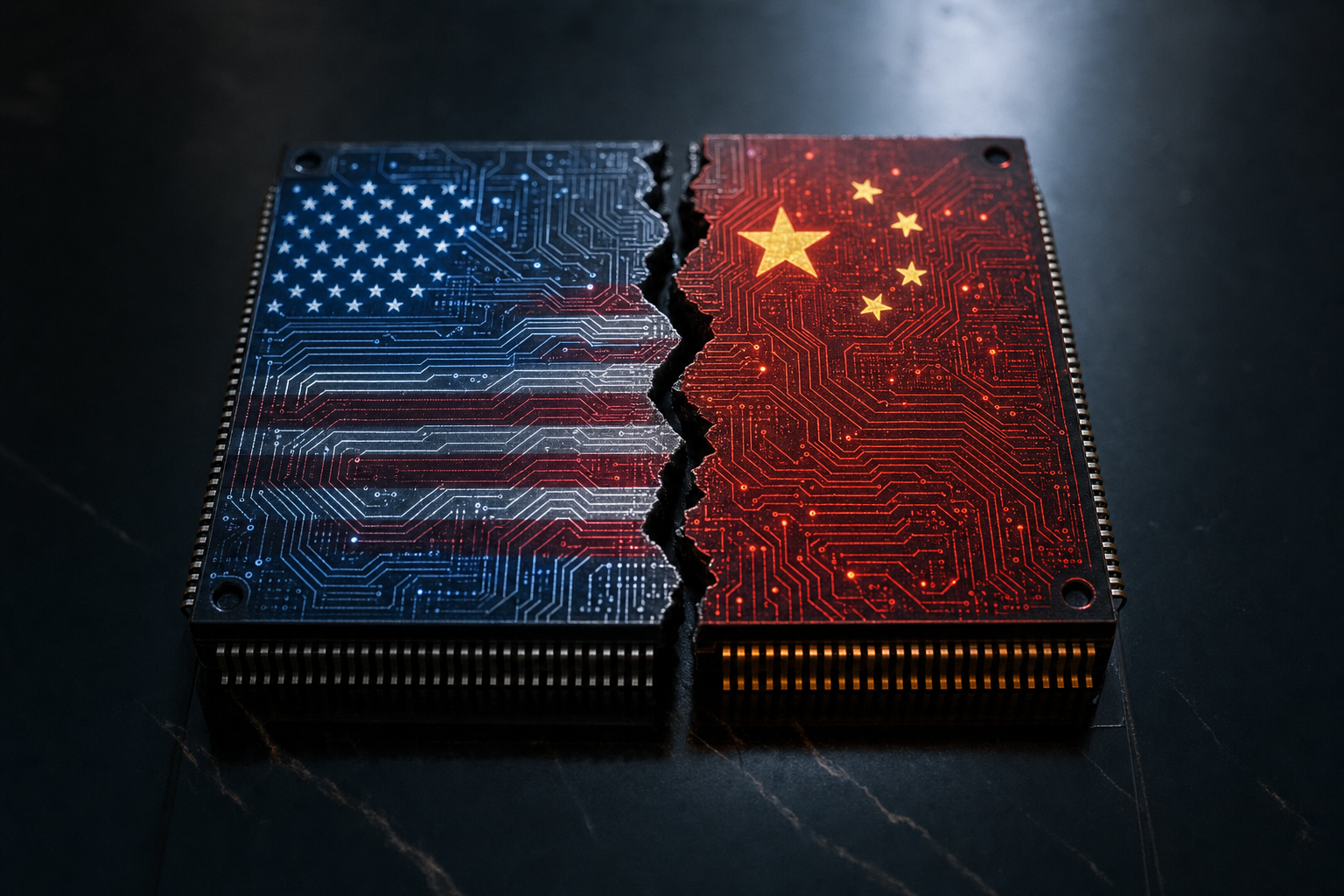
Over the past several days alone, the US and China have each taken a new series of steps that make plain what many industry observers have been warning about for years: the world’s two largest economies are no longer competing within a shared technological ecosystem. They are building two entirely separate ones. And every company, government, and consumer in between will eventually have to choose a side.
The FCC Closes the Door
The US Federal Communications Commission voted unanimously to ban all Chinese laboratories from certifying consumer electronics for sale in the United States. The scope of this rule is enormous — approximately 75% of US-bound electronic devices are currently tested in Chinese labs, meaning the practical disruption to global supply chains will be immediate and significant.
The rule would affect phones, laptops, cameras, routers, and virtually any radio-frequency connected device that currently undergoes FCC certification testing — a process that many Chinese manufacturers use as a gateway to US retail shelves. Chinese electronics firms and their global customers will need to rapidly identify alternative certified testing facilities, many of which are based in Europe, Taiwan, or the US itself.
This wasn’t the FCC’s only move. In March 2026, the commission enacted a ban on all new foreign-made consumer routers sold in the US market. The target is widely understood to be TP-Link, a Chinese manufacturer that holds a dominant share of the US home and small business router market. TP-Link’s presence in home networking infrastructure has been a growing concern in Washington due to the potential for hardware-level security vulnerabilities in devices sitting at the heart of every connected home and office.
China’s Data Center Counter-Move
Beijing has not been passive. In a move with sweeping implications for the global semiconductor industry, China has mandated that all state-funded data centers switch exclusively to domestically produced AI chips — effectively banning Nvidia, AMD, and other US suppliers from one of the most significant infrastructure build-outs in the world.
China is currently investing hundreds of billions in AI compute capacity, with state-linked entities constructing data centers at a pace that rivals anything seen in the US or Europe. Until recently, that infrastructure relied heavily on Nvidia’s H-series GPU hardware. Under the new mandate, that business is closed off — for any project touching government or state enterprise funding.
For Nvidia, this represents a material revenue risk. The company had already seen its China business disrupted repeatedly by successive rounds of US export controls on advanced chips. The new Chinese mandate takes the problem in the opposite direction: it’s not just that Nvidia can’t sell certain chips to China — it’s that China is actively building the capacity to no longer want them. Domestic champions like Huawei’s Ascend chip division and Moore Threads are being positioned as the primary beneficiaries, though independent assessments suggest Chinese domestic AI chips still lag behind Nvidia’s latest hardware in raw performance. The mandate is as much a political signal as a technical decision — China is telling the world it is prepared to accept a performance trade-off in exchange for supply chain independence. For data center operators and semiconductor distributors globally, that trade-off has enormous downstream consequences.
Meta, Manus, and the New Rules of Acquisition
Perhaps the most striking single development was Beijing’s intervention to force Meta to divest its $2 billion acquisition of Manus, a Chinese AI startup that had relocated to Singapore before the deal. The acquisition, which Meta had hoped would give it access to advanced agentic AI capabilities, was blocked by China’s National Development and Reform Commission (NDRC) on national security grounds — after a months-long probe.
This mirrors almost exactly the kind of foreign acquisition blocking that the US Committee on Foreign Investment (CFIUS) routinely applies to Chinese acquisitions of American tech companies. The symmetry is not accidental. China is increasingly applying the same logic to inbound investment from US tech giants that Washington applies to Chinese investment in Silicon Valley. Cross-border M&A in AI and advanced technology is quietly becoming untenable in both directions.
The Narrative War
Running alongside the regulatory and commercial moves is an active battle over public perception. A campaign called “Build American AI,” funded by networks linked to OpenAI investors and Andreessen Horowitz, has been paying social media influencers to frame Chinese AI development — and Chinese AI products like DeepSeek — as inherent national security threats. The campaign has drawn scrutiny for blending legitimate security concerns with competitive commercial interests, making it difficult for policymakers, businesses, and the public to distinguish genuine risk from market positioning.
This narrative dimension matters. The decisions that governments and businesses make about which AI systems to adopt, which chips to use, and which cloud platforms to trust are increasingly shaped not just by technical performance or price, but by geopolitical framing. A world where technology choices are made primarily on the basis of national allegiance — rather than capability or value — is a less efficient, more fragmented, and ultimately more costly world to operate in.
The Fork in the Road
For technology companies operating globally — electronics distributors, component manufacturers, software vendors, data center operators — the bifurcation of the tech world presents an immediate strategic challenge. Supply chains that once spanned both US and Chinese ecosystems must now be audited for geopolitical exposure. Product roadmaps must account for the possibility that a chip, a router, or a software platform that is acceptable in one market may be banned in another.
The companies best positioned to navigate this environment are those that understand it not as a temporary disruption, but as the new structural reality of global technology. The decisions being made in Washington and Beijing right now — about data centers, about chips, about who gets to build the AI infrastructure of the next decade — will define the competitive landscape for years to come. The digital iron curtain is not coming down. If anything, it is still going up.