For much of the past several decades, technology leaders treated geopolitics as a secondary concern, something relevant to regulators and diplomats but largely detached from product strategy and revenue planning. That assumption no longer holds. Geopolitics has become a defining structural force, shaping which technologies can be sold, where, under what conditions, and for how long.
The experiences of companies such as Advanced Micro Devices, Huawei, Intel, Taiwan Semiconductor Manufacturing Co. Ltd. (TSMC), and Nvidia illustrate this shift. Nvidia’s most advanced GPUs are no longer viewed merely as commercial components; they are now regarded as strategic assets central to U.S. industrial and national security policy.
At the same time, China — once the industry’s most important growth market — has become a high‑risk environment governed by export controls, informal policy guidance, and state‑directed substitution. This is not a temporary disruption but a structural redefinition of addressable markets and business models.
Three Structural Realities
First, advanced technology is increasingly securitized. High‑end semiconductors, cloud infrastructure, critical software, and essential equipment are now treated as national infrastructure. Export licensing, end‑use restrictions, security reviews, and industrial policy have moved from the periphery to the center of market access decisions. Western firms have learned this through successive rounds of export controls and investment scrutiny, while Chinese companies face parallel constraints as they are directed to serve national resilience objectives rather than purely commercial ones.
Second, revenue is no longer politically neutral. In a world defined by strategic rivalry, revenue earned in geopolitically sensitive markets carries materially higher risk. Nvidia’s rapid shift from deep exposure to China to effectively excluding it from forward guidance demonstrates how quickly politically exposed revenue can disappear. Chinese firms face similar vulnerabilities in Western and allied markets due to sanctions, entity listings, data‑sovereignty rules, and security‑driven procurement barriers. Boards that continue to prioritize market size over political reliability are systematically underestimating risk.
Third, the neutral supplier model has eroded. When a company’s technology underpins the strategic capabilities of one geopolitical bloc, rival blocs will treat that firm as aligned regardless of its stated neutrality. Nvidia is now firmly embedded within a U.S.‑anchored ecosystem of fabs, cloud providers, and defense‑adjacent applications, prompting Chinese planners to view its products as transitional and ultimately replaceable. Chinese technology champions face the inverse problem: once framed as extensions of state strategy, they are no longer perceived in Western markets as conventional commercial vendors.
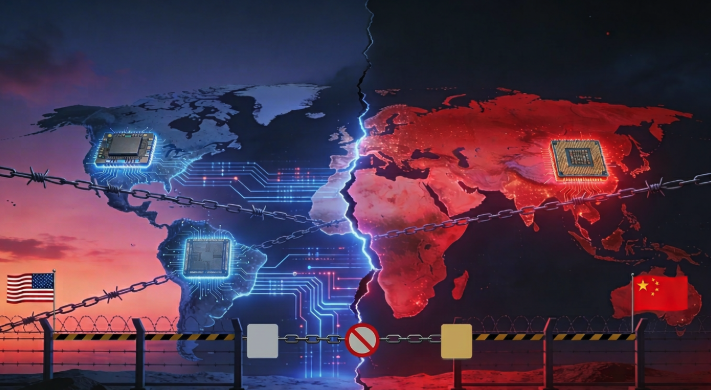
These dynamics extend well beyond individual firms or bilateral trade corridors. They are reshaping supply chains for lithography tools, memory, networking equipment, cloud infrastructure, submarine cables, critical minerals, and consumer devices. Although the policy instruments vary — export controls, localization mandates, or domestic‑content rules — the outcome is consistent: technology markets are being reorganized along geopolitical lines.
Strategic Questions for Leaders
This environment demands a reassessment of core strategic assumptions. Companies must ask whether their products are being treated as strategic assets subject to sustained political oversight. They must evaluate how much revenue depends on markets their home governments classify as competitors or adversaries and discount that exposure accordingly. They must also distinguish between market‑specific product variants that preserve long‑term value and those that merely delay inevitable substitution.
Nvidia offers an early and instructive example of how geopolitics can harden into market structure. Firms on both sides of the strategic divide are now confronting similar constraints. The broader lesson is clear: geopolitics is no longer an external shock to be managed episodically. It has become an integral component of market architecture, and strategy must be rebuilt on that foundation.
Bolaji Ojo is a principal analyst and founder of GeoTechNexus. He is reachable at bojo@geotechnexus.com.